
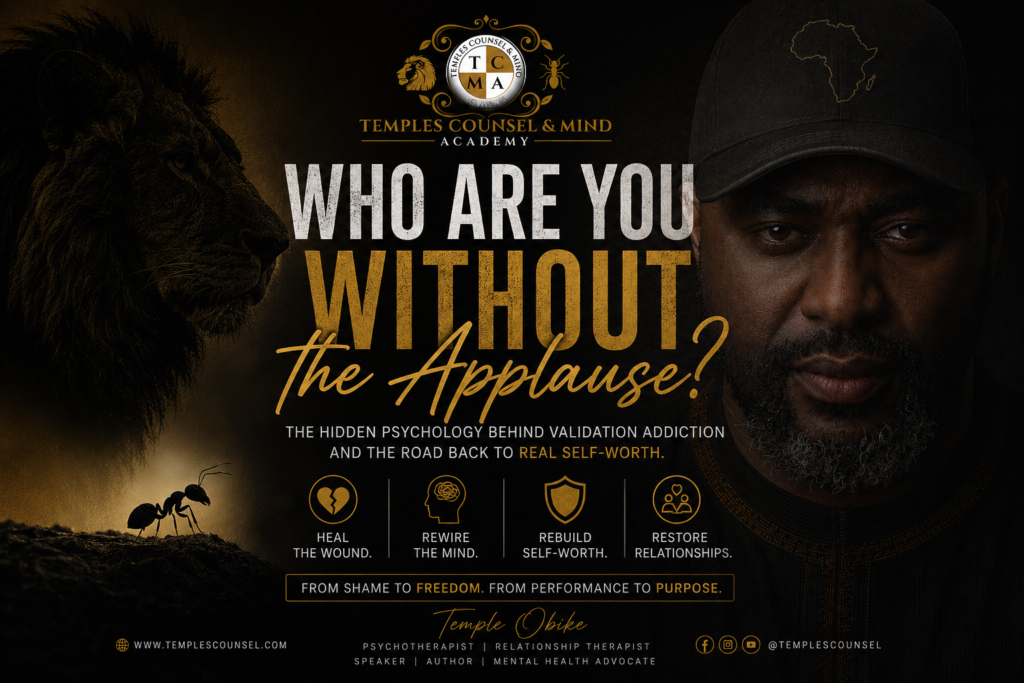
Who Are You Without the Applause? I always use this question for client grounding exercises and it would shock you to know that almost 53% struggle to answer this question.
Let Me Tell You a Little Story,actually two stories…
Over the past 17 years of working with people, I have learnt something that still surprises me. Most of the problems we see in adulthood are rarely about adulthood. They are about childhood wounds that found more sophisticated hiding places.
A woman sits in front of me. She is beautiful. Intelligent. Quite popular, Successful. Married. Thousands of people engage with her online content. Men constantly compliment her. Her photographs attract admiration. Her social media pages are filled with hearts, fire emojis, and messages from strangers reminding her how attractive she is.
Yet beneath all of that attention sits a little girl who never felt seen.
A little girl whose father was physically present but emotionally absent. A little girl who spent years trying to earn affection that was rarely given freely. A little girl who learnt that attention had to be earned, chased, performed for, or fought for. Every compliment she receives today feels like a small repayment of a debt she never should have carried in the first place.
Then again, a man sits in front of me. He’s
Confident on the outside. Charming. Accomplished. Popular. The kind of man people assume has high self-esteem. Yet beneath the confidence, all i see is a little boy who grew up feeling invisible. A boy whose father criticised more than he affirmed. A boy who learnt that mistakes were remembered longer than achievements. A boy who spent years wondering whether he was enough. Today, every female admirer, every flattering message, every expression of desire provides a temporary answer to a question he has been asking his entire life.
The tragedy is that neither of them realise they are still responding to childhood.
One of the darkest truths about human psychology is that many adults spend their lives searching for witnesses. Not love. Not intimacy. Witnesses. People who can look at them and confirm that they matter. People who can temporarily silence the voice of shame that has followed them since childhood. Shame is a powerful emotion because it does not say, “I made a mistake.” Shame says, “I am the mistake.” It becomes woven into identity. It shapes relationships. It influences choices. It quietly sits in the background of adulthood, influencing behaviour long after the original wounds have been forgotten.
This is why validation can become addictive. It is not the compliment itself that becomes intoxicating. It is the relief. For a few moments, the shame goes quiet. For a few moments, the insecurity loosens its grip. For a few moments, the individual feels significant, desirable, worthy, and enough. Unfortunately, emotional relief is not the same thing as emotional healing. Relief fades. Healing transforms. Relief requires repetition. Healing creates freedom. That is why validation dependency becomes a cycle. The person is not chasing attention. They are chasing relief from pain they have never properly addressed.
Social media has become one of the most effective delivery systems for this emotional drug. Previous generations could only access validation from a small circle of people. Today, someone can receive hundreds of micro-doses of approval before breakfast. Every notification becomes a psychological reward. Every compliment becomes evidence. Every reaction becomes reassurance. The wounded child within whispers, “Maybe now we are enough.” Yet the feeling never lasts because strangers can never heal wounds they did not create.
Many people do not realise that they have spent years building an identity around being admired. They have become experts at attracting attention while remaining strangers to themselves. They know how to create desire. They know how to create curiosity. They know how to create admiration. Yet when they sit alone without an audience, they often struggle with a question that terrifies them: “Who am I when nobody is looking?”
This is where the work begins.
Healing starts when a person becomes willing to stop treating attention as medicine. It starts when they become curious about the pain beneath the performance. It starts when they stop asking, “Why do I enjoy compliments?” and begin asking, “Why do I need them so much?” The answer to that question often leads back through years of rejection, neglect, abandonment, criticism, humiliation, comparison, and shame. Not because people are weak, but because wounds ignored do not disappear. They simply change shape.
What concerns me today is that we are raising a generation that is becoming increasingly skilled at managing perception while becoming increasingly disconnected from identity. We are teaching people how to be visible, but not how to be secure. We are teaching people how to gain attention, but not how to build self-worth. We are teaching people how to attract an audience, but not how to heal the parts of themselves that believe they need one.
The goal is not to stop being attractive. The goal is not to disappear from social media. The goal is not to reject admiration. The goal is to reach a place where your value no longer rises and falls with other people’s opinions. A place where compliments are appreciated but not required. A place where attention is enjoyed but not depended upon. A place where your sense of worth comes from within rather than from an audience.
Because the day you no longer need strangers to tell you who you are is the day you finally begin to discover who you have been all along. If this resonates with you, follow my instagram page and comment “Temple, Send me the workbook on validation dependency”. https://www.instagram.com/templescounsel/
Written by Temple Obike
Psychotherapist | Relationship Therapist | Founder, Temples Counsel & Mind Academy