
A husband sits across from me in therapy. There are no hotel receipts, no explicit messages, and no evidence of a physical affair. Yet something is deeply troubling him. The worst part is that before he came here, the damage had already been done …
His concern is not what many people would consider serious. It is the photographs, the writeups that hint at something, the captions, the carefully chosen angles, the subtle flirtation hidden behind seemingly innocent posts. He cannot quite explain why it bothers him so much, but he feels it there. The same conversation emerges from wives who watch their husbands curate online personas that look remarkably different from the men they come home to. An image women gobble up so satisfactorily with no questions asked. On the surface, it seems like a social media issue. Beneath the surface, it is often a trust issue.
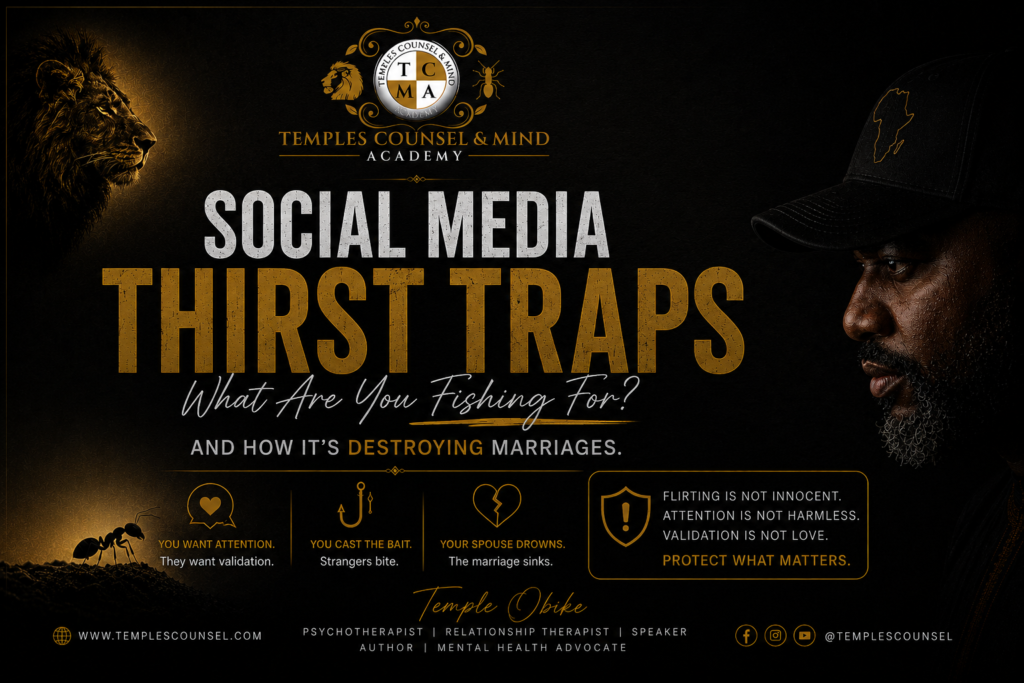
One of the most dangerous lies of the digital age is the belief that attention and affection are the same thing. They are not. Attention can be given by anyone. Affection requires investment. Attention requires seconds. Love requires sacrifice. Yet many people have unconsciously trained themselves to crave attention because it is easier to obtain than genuine intimacy. A photograph can attract hundreds of admirers in minutes. Building emotional closeness with a spouse requires patience, vulnerability, accountability, and effort. Social media offers a shortcut to feeling desired without demanding the work that real connection requires. This is why the discussion about thirst traps is often misunderstood. The issue is rarely the picture itself. Attractive people have every right to be attractive. The deeper question is intent. What emotional need is the post attempting to satisfy? Human beings naturally enjoy appreciation, but there is a significant difference between enjoying admiration and depending on it. The moment validation becomes a necessity rather than a pleasant bonus, a dangerous shift has occurred. The individual is no longer expressing confidence; they are feeding a hunger. And hunger, by its nature, always returns.
One of the darker realities of human psychology is that many people seek validation not because they are full of confidence, but because they are struggling with insecurity. The compliments become temporary painkillers. The likes become reassurance. The direct messages become evidence that they still have options, still have value, still have influence or looks. What appears to be confidence from the outside is often anxiety wearing expensive clothing.
The person is not asking the world to admire them. They are asking the world to reassure them. Unfortunately, reassurance obtained from strangers expires quickly, which is why the cycle repeats itself endlessly.
Marriage becomes vulnerable when one partner begins drawing emotional nourishment from an audience rather than from the relationship itself. At that point, the spouse is no longer competing with another man or another woman. They are competing with the addictive nature of public validation. An audience is easy to impress because it demands nothing. It does not ask for accountability, emotional maturity, conflict resolution, commitment, or sacrifice. It simply rewards appearance and performance. Over time, some individuals become more invested in maintaining their desirability to strangers than nurturing their connection with the person they promised to love.
What many couples fail to realise is that emotional betrayal often begins long before physical betrayal. It begins when someone starts needing external confirmation of their worth despite being fully loved at home. It begins when a married person quietly enjoys creating uncertainty about their availability. It begins when boundaries become flexible and admiration from outsiders becomes emotionally exciting.When “I AM MARRIED” is no longer said with confidence but rather quickly glossed over rather than made the real topic that starts building confidence in self and spouse. Some people are not actively looking for another relationship. They are looking for proof that another relationship remains available if they ever decide they want one. That desire rarely comes from strength. More often, it comes from fear, insecurity, unresolved wounds, or an identity that has become dependent on being desired.
The tragedy is that social media has normalised behaviour that previous generations would have immediately recognised as boundary violations. We now live in a culture where people openly seek attention while insisting that attention means nothing. We have normalised flirtation disguised as self-expression, validation disguised as confidence, and emotional dependency disguised as empowerment. In the process, many couples are losing something they desperately need: emotional safety. Trust is not only damaged by affairs. Trust is damaged whenever one spouse repeatedly communicates, intentionally or unintentionally, that the admiration of strangers carries significant emotional value.
The question every married couple must answer is not whether social media is good or bad. The real question is whether their online behaviour strengthens or weakens the bond they are trying to build. Every post communicates something. Every caption tells a story. Every interaction reveals a priority. Healthy marriages are not built merely on love; they are built on boundaries, intentionality, and mutual respect. If a spouse repeatedly expresses discomfort about certain online behaviours, the issue should never be dismissed as insecurity before honest reflection takes place. Sometimes insecurity is present. At other times, discomfort is simply a warning signal that a boundary is being crossed.
The greatest threat to many modern marriages is not another man or another woman. It is the growing temptation to outsource self-worth to strangers. The moment a person’s identity becomes dependent on public validation, no amount of love from a spouse will ever feel sufficient. The problem was never the absence of love. The problem was a wound that attention was being used to conceal. Wounds hidden beneath applause do not heal. They simply become louder when the applause fades.
Written by Temple Obike
Psychotherapist, Relationship Therapist, Founder of Temples Counsel & Mind Academy, and advocate for healthier relationships, emotional intelligence, and family systems across Africa.
https://www.instagram.com/templescounsel/